Young Stellar Objects
Young Stellar Objects (yso)
Young stellar objects (YSOs) exhibit a wide range of variability types, with many subclasses depending on the dominant physics in the system.
Classification and numbers
- Supertypes
- Variable
- Subtypes
- simple sinusoidal
- quasi-periodic
- stochastic
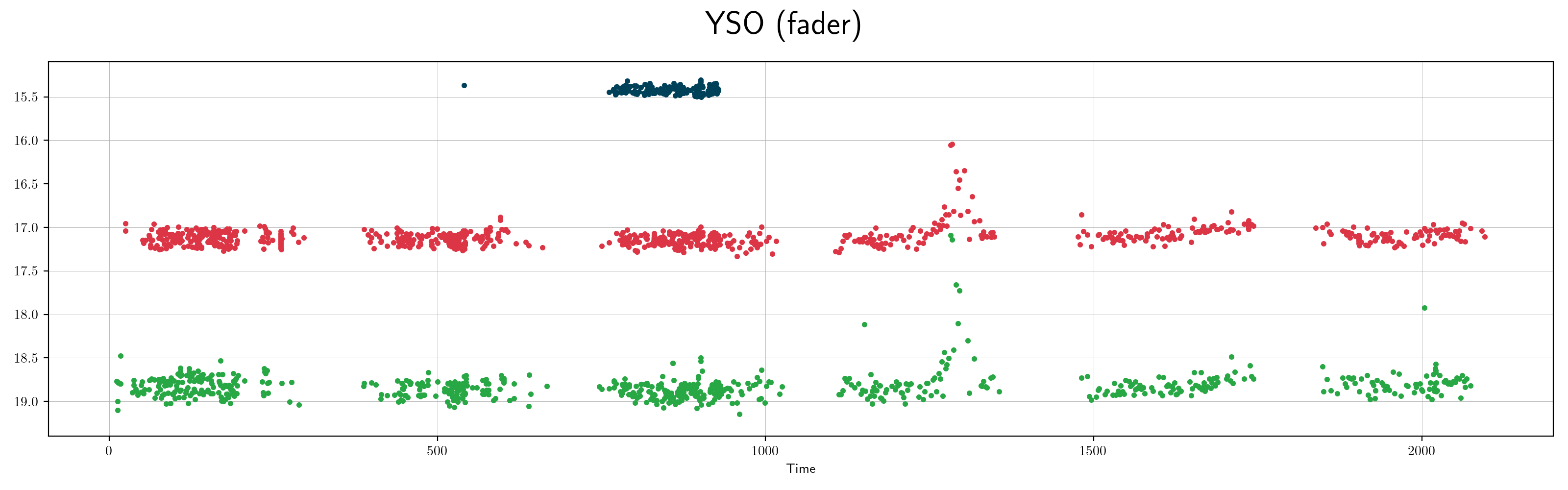
- faders
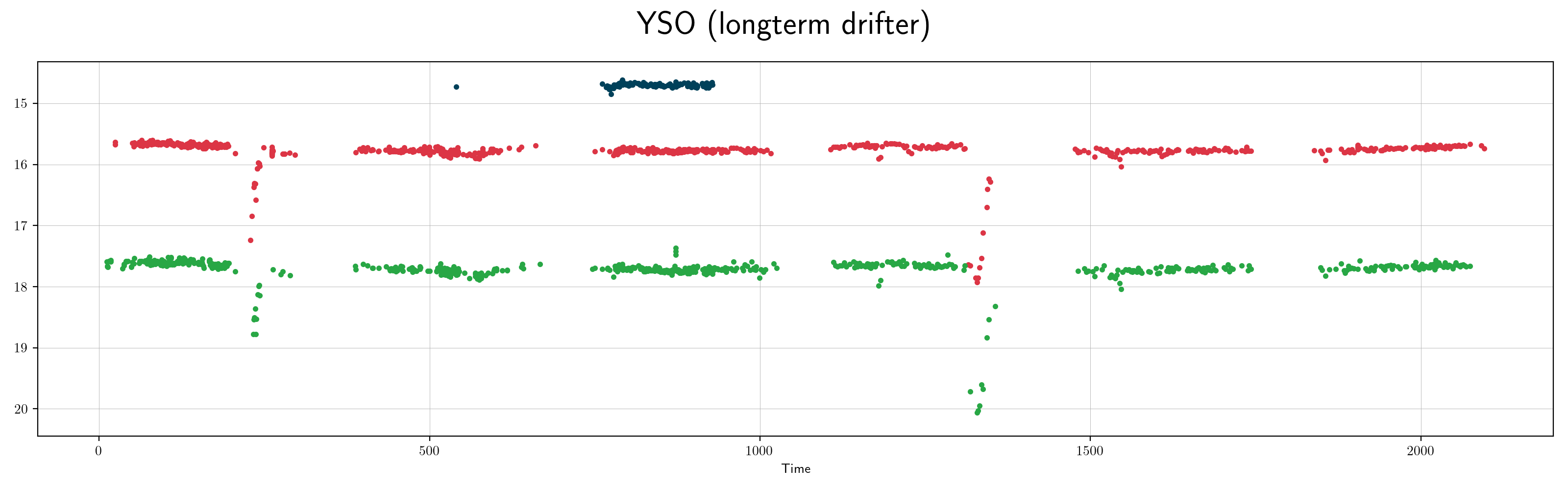
- longterm drifters
- Occurrence rate: common, about 104 expected in ZTF data
ZTF light curves
Description
YSOs are not smooth variables like pulsating (e.g. RR Lyr) or eclipsing (e.g. Algol or EA) classes. Instead, because the light curves are generally the result of several superposed physical effects, they can appear quite messy. They thus may satisfy the criteria for two or even more of the light curve categories below. Yet one subclass often dominates.
Light curve characteristics
-
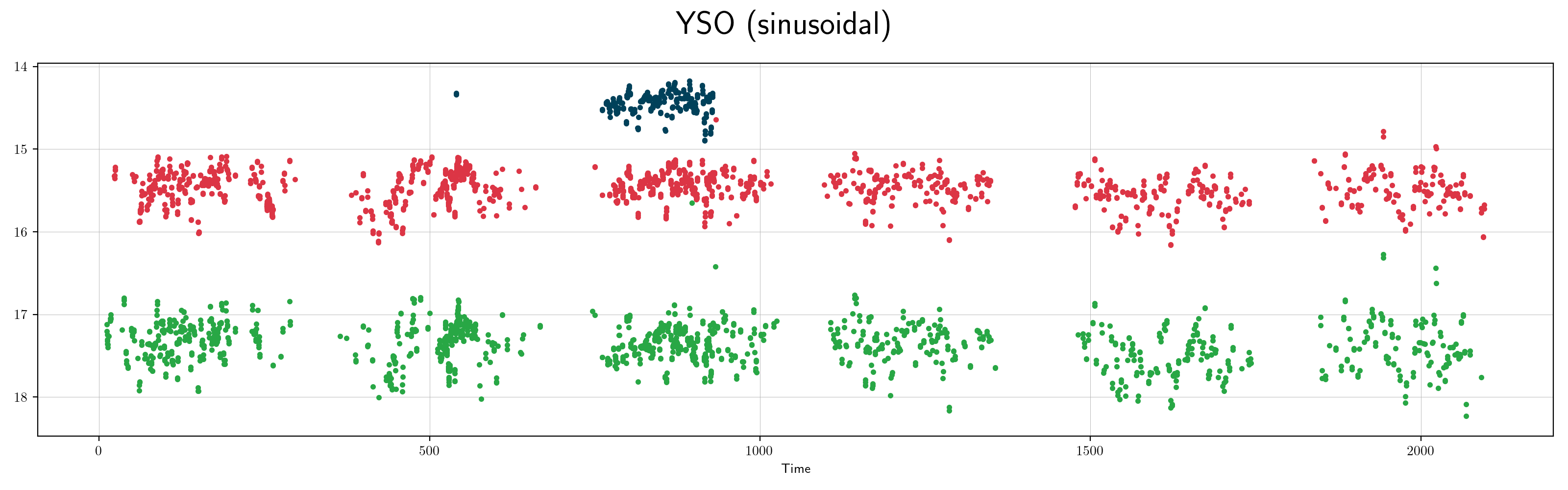
simple sinusoidal periodicity (caused by rotating star with cool or hot spots)
-
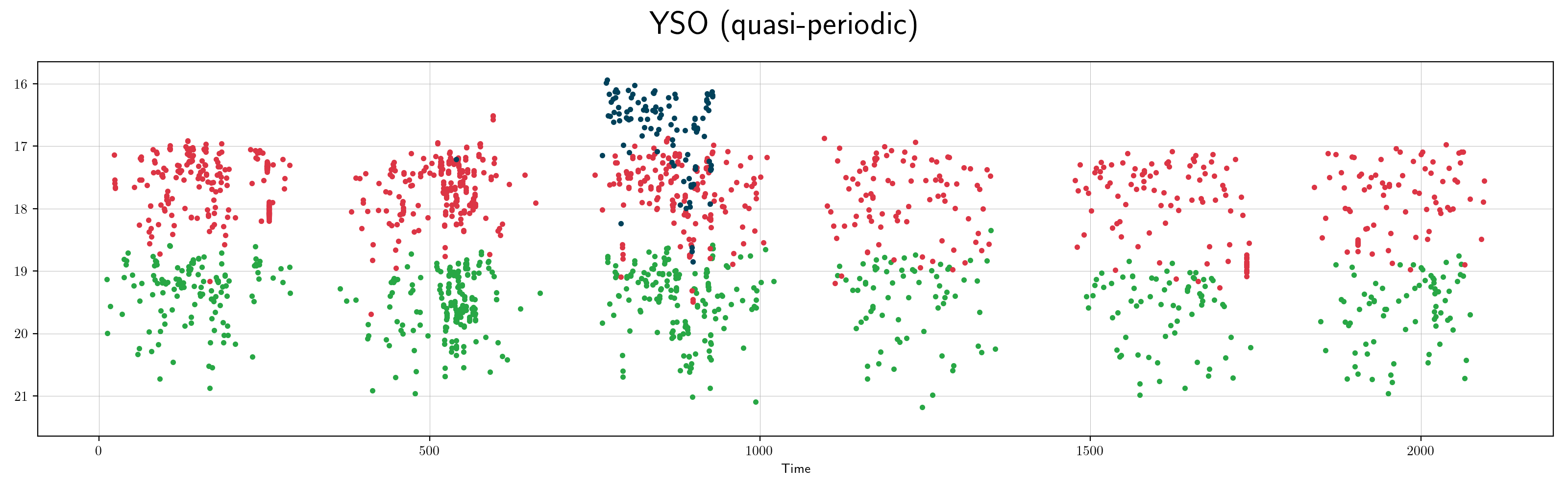
quasi-periodic behavior, which is a periodicity on which stochastic behavior is superposed (caused by accreting star with rotational modulation)
-
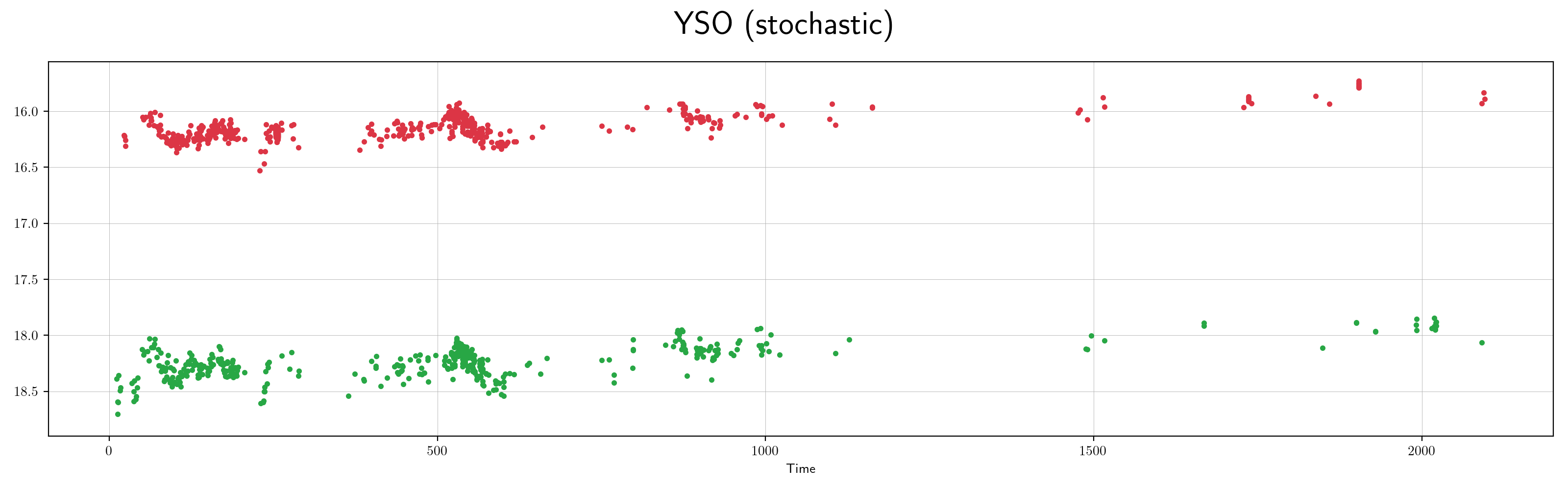
stochastics, appearing similar to a damped random walk, with time scales from hours to weeks and usually symmetric around a mean (caused by accreting star with accretion effects dominating rotation effects)
-
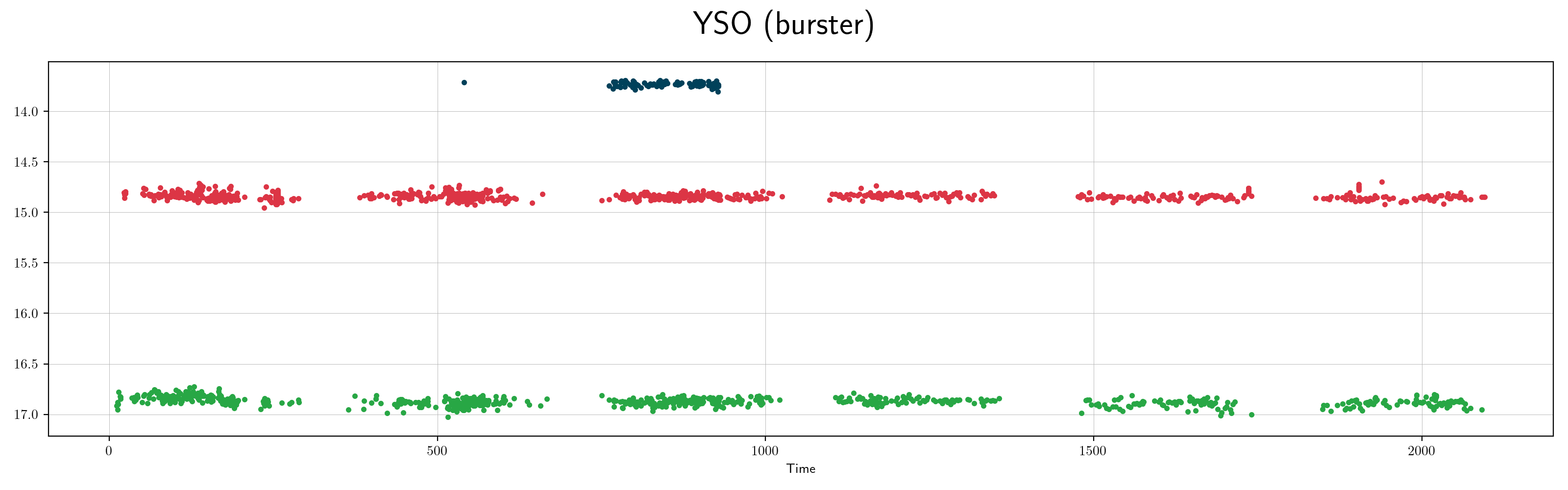
bursts, which are brightening episodes that can last from many hours to days or possibly weeks; they are longer than flares which decay within minutes to hours (caused by clumpy accretion, rather than smooth accretion, due to a build-up of material in the transition zone between the stellar magnetosphere and the disk)
-
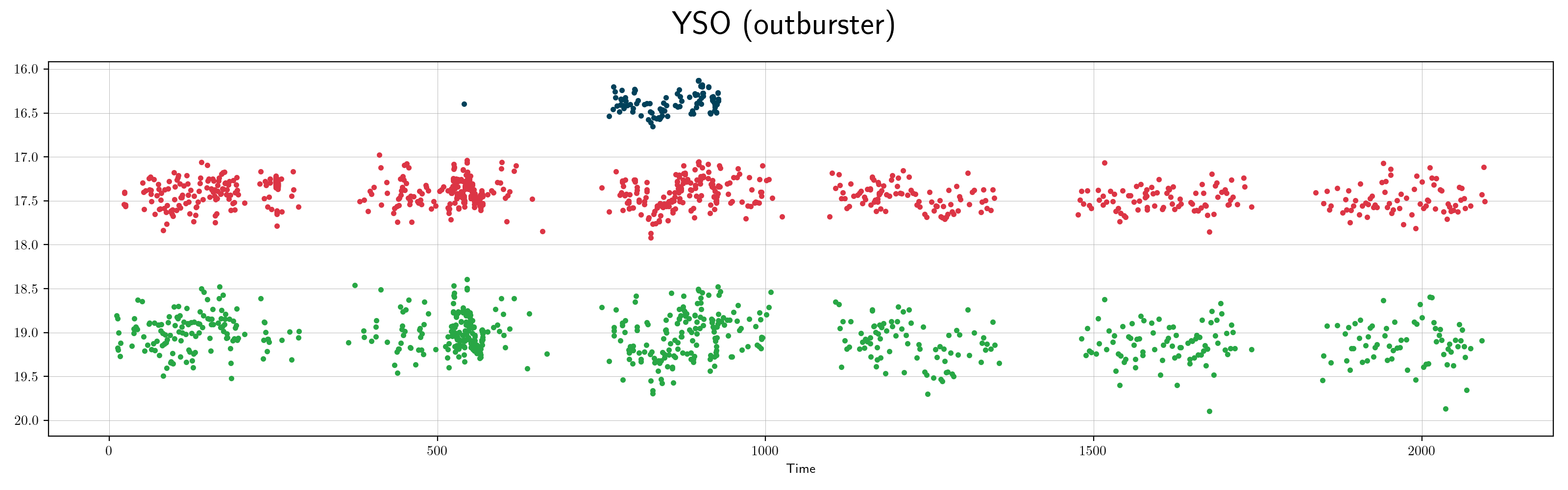
outbursts, like the above, but much larger amplitudes of 2-5 mag and much longer durations of months to decades (caused by accretion events driven by instabilities in the magnetosphere/disk interaction region, or the inner disk)
-
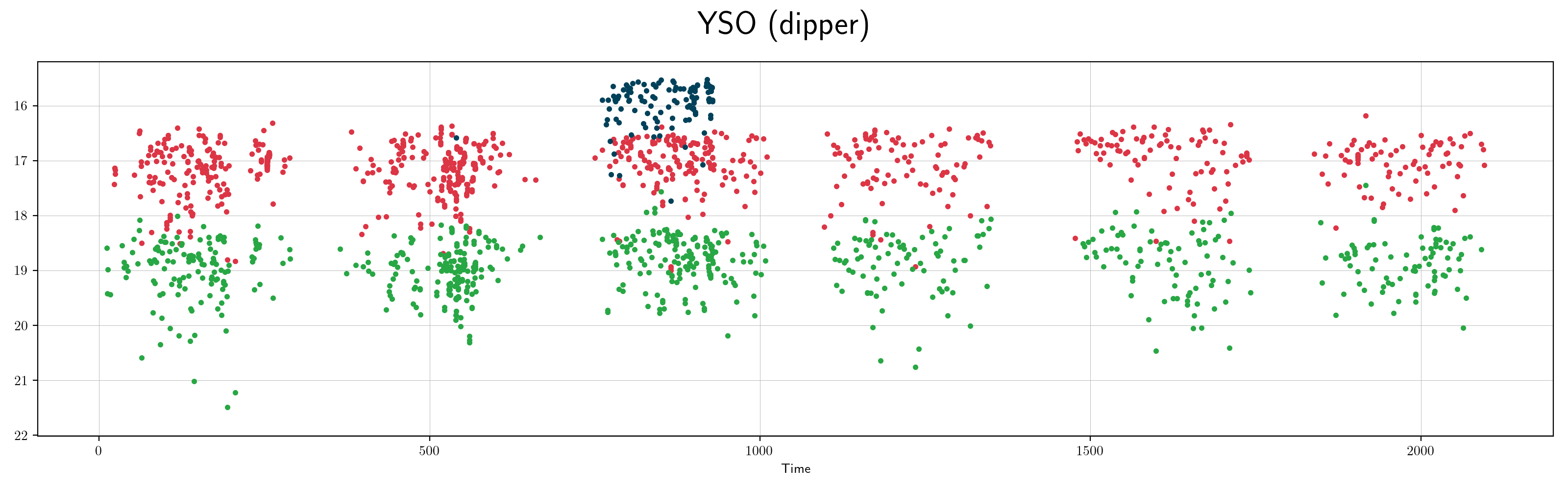
dippers, which have timescales similar to bursts, but are fading events of a few percent to tens of percent, rather than brightening, and can last many hours to days (caused by dust in the magnetosphere/disk interaction region that can be co-rotating with the star, in which case the source could be called a quasi-periodic dipper)
-
faders, like the above, but much larger amplitudes of 2-5 mag and longer durations, of weeks to years (caused by dust that is somewhat further out in the disk and has rotated into the line of sight)
-
longterm drifting behavior over a significant fraction of the time series, with gradual dimming or brightening over months to years (caused by slowly evolving changes in extinction or accretion)
Other characteristics and selection methods
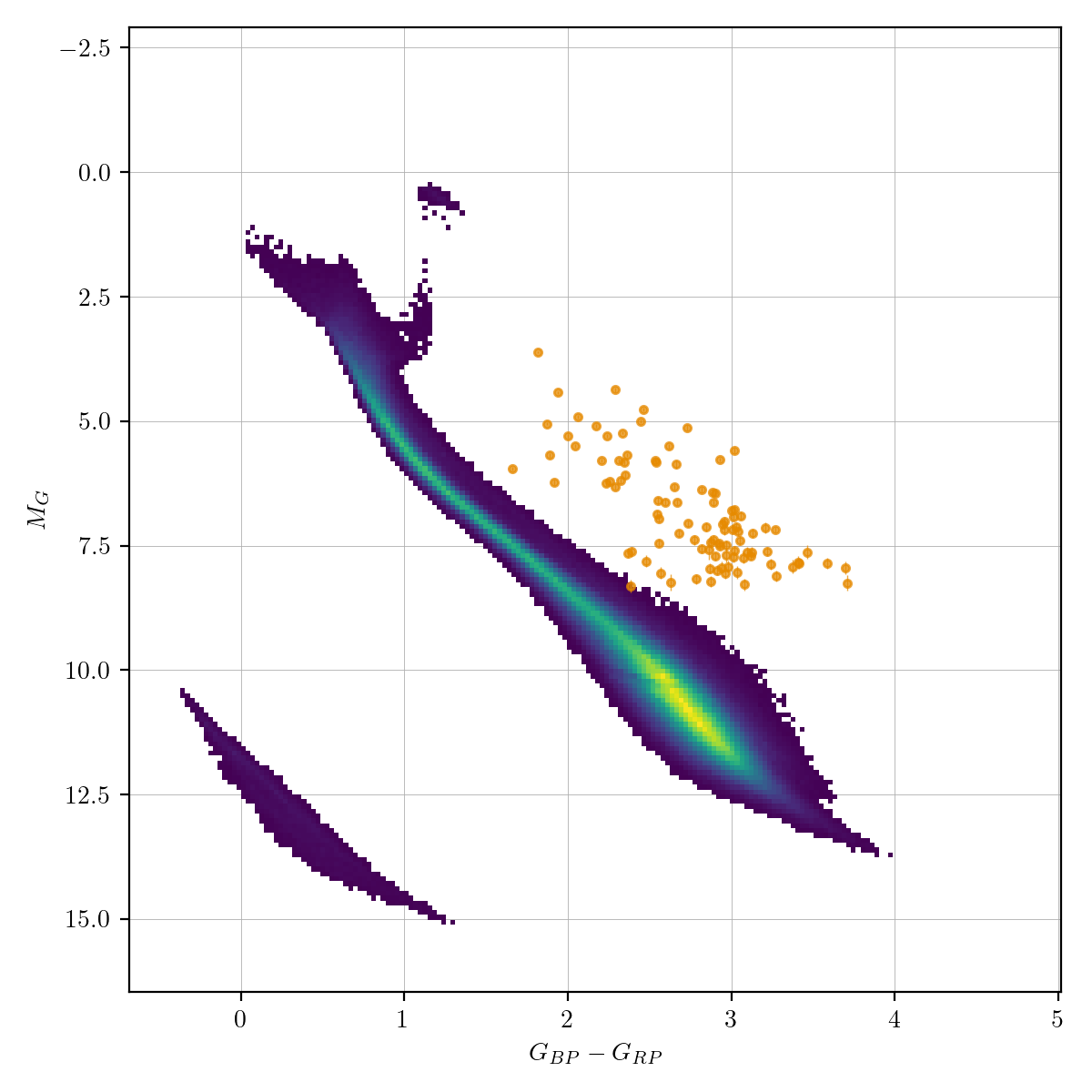
- In addition to the variability characteristics described above, young stellar objects must reside above the main sequence, as they are still contracting and are not yet stable hydrogen burning objects on the main sequence. The periodic objects typically lack disks, but the other variability classes typically have infrared excess (large WISE or 2MASS colors) that imply the presence of a disk.